Sep 28, 2026Buying Guides
How to Choose a Jump Starter: 7 Specs to Check Before You Buy
A buyer's guide to the seven specs that decide jump starter fit: capacity, current, engine size, voltage, extra functions, charging speed and certifications.
You are standing next to a delivery van with a dead battery on a Monday morning, or you run a workshop where two or three cars a day arrive with the same problem. A jump starter can solve it in minutes, but only if the unit matches the engine in front of you. Choosing wrong means a booster that will not turn the engine over, no matter how bright its display looks. This guide walks through the seven specs that decide fit before you order, with examples from the JinYaoe range.
QUICK ANSWER
Check three numbers first: capacity from 10,400 mAh up to 63,000 mAh, peak current from 800 A up to 10,000 A, and engine compatibility from 4.0 L gas / 2.0 L diesel up to 32.0 L gas / 19.0 L diesel. These values refer to the JinYaoe catalog and should be confirmed against the model spec before purchase.
01 CHECK THE CAPACITY
Capacity tells you how much energy the unit stores, shown in mAh or Wh. It matters twice: a higher number means more starts between charges, and it means the power bank side can charge phones and tablets longer on the road. The JinYaoe line runs from 10,400 mAh on the LK2 to 63,000 mAh / 233.1 Wh on the L090. Choose the low end for a private car used occasionally, and move up for fleet work or tools that run all day. Capacity alone does not start an engine, so pair it with the current specs below.
02 READ PEAK VS STARTING CURRENT
A jump starter carries two current numbers. Peak current is the maximum burst it can deliver for a moment; starting current is roughly half the peak and is the number that decides whether an engine turns over. In the JinYaoe range, peak current runs from 800 A on the LK2 up to 10,000 A on the L090. When comparing two units, compare the same number, because peak and starting values look very different. A unit sized for a cold diesel needs far more than one sized for a warm petrol car.
03 MATCH THE ENGINE SIZE
Engine compatibility is usually written in litres of displacement, with petrol engines needing less than diesel engines of the same size. The smallest model, the LF57, starts below 4.0 L gas and 2.0 L diesel. The largest, the L090, covers up to 32.0 L gas or 19.0 L diesel. In between, the LF39 starts up to 17.0 L diesel or 36-tonne trucks. If your fleet mixes small vans and heavy trucks, one unit cannot cover both ends, so pick the model whose limit sits above your biggest engine.
04 CONFIRM 12 V OR 24 V
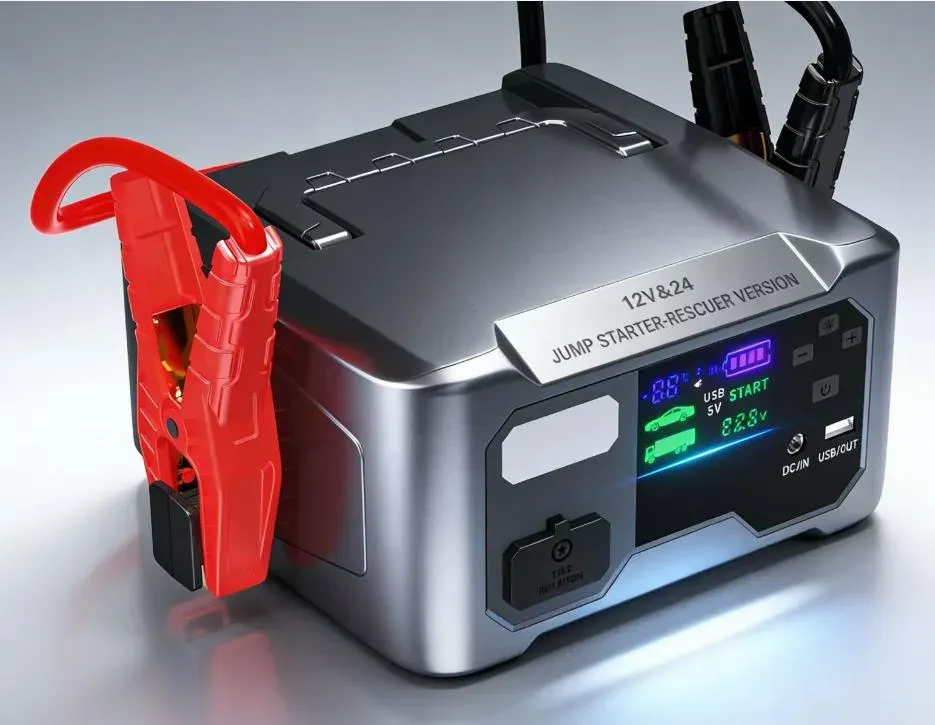
Most cars, vans and light trucks run 12 V electrical systems, and most jump starters are 12 V units. Heavy trucks, buses and some marine engines run 24 V, and a 12 V unit will not start them. The L090 and the LF39 support both 12 V and 24 V, which makes them the flexible choice for mixed fleets. Check the vehicle plate or the battery label before you order, because voltage errors are the quickest way to buy the wrong model.
05 DECIDE ON AIR PUMP AND EXTRA FUNCTIONS
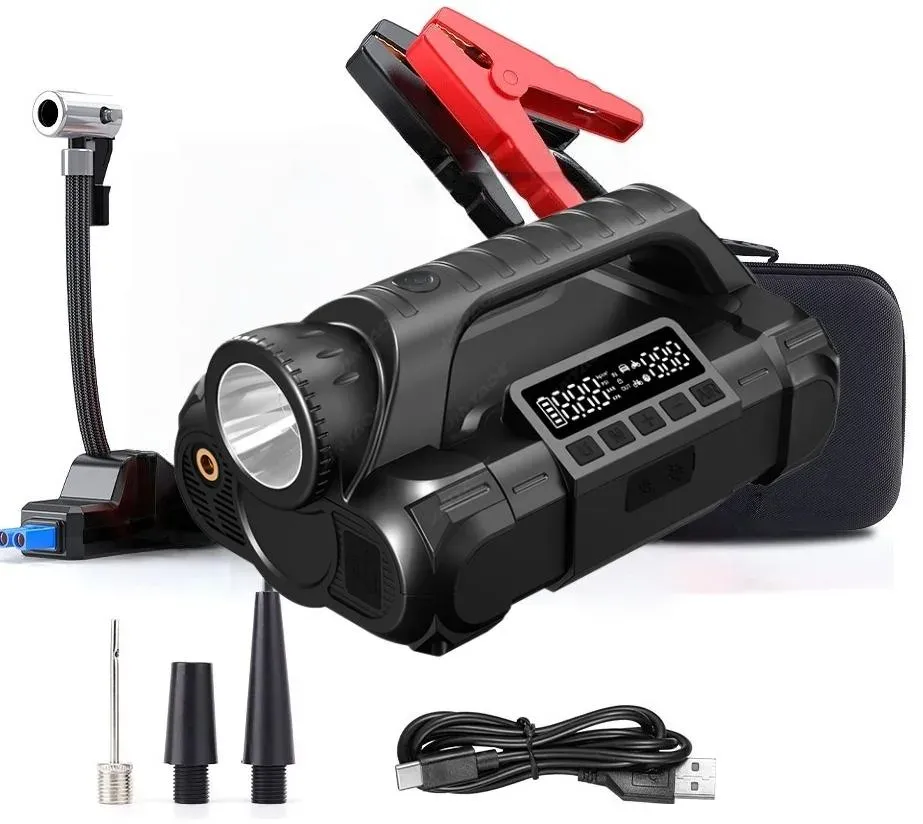
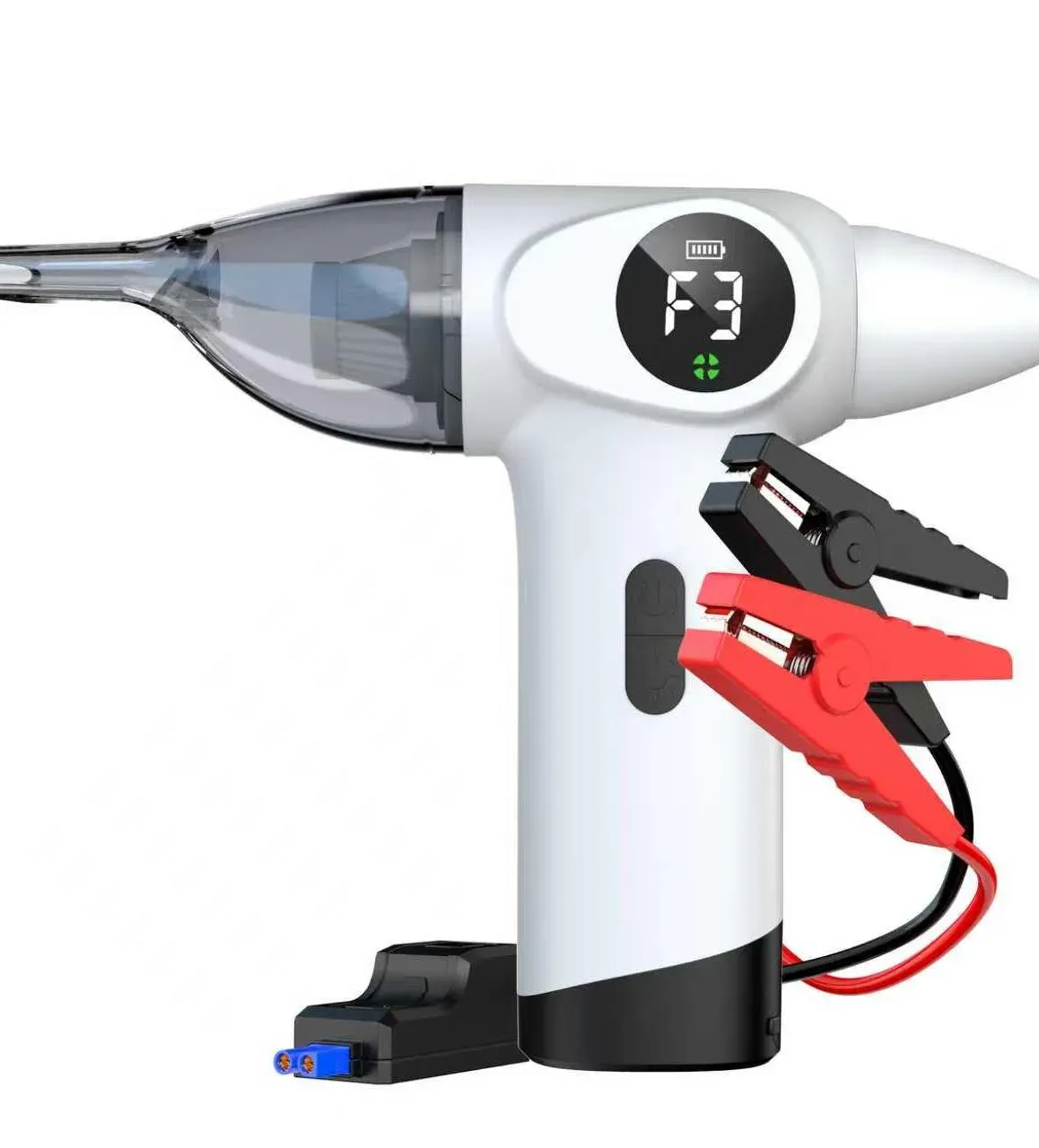
Multi-function models combine a jump starter with an air pump, power bank and flashlight. The air pump inflates tyres to 150 PSI or 160 PSI and stops by itself at the set pressure. Some models add a vacuum cleaner, dust blower, voltmeter or wireless charging. The L087 is a 6-in-1 unit with 20,000 mAh and 3,000 A peak, useful when one device must serve a car, a bike and a camping trip. Extra functions add size and cost, so only pay for the ones your drivers will actually use.
06 LOOK AT CHARGING SPEED
Fast charging matters in both directions. The PD standard covers the input that refills the jump starter and the output that charges phones, tablets and laptops from it. JinYaoe models offer PD18W, PD45W, PD65W and PD140W across the range. Higher wattage means the unit is ready again sooner after a night in the van, and it can keep crew devices running through a long day. Match the wattage to how often the unit will be drained and refilled.
07 CHECK THE CERTIFICATIONS
Certifications are the paper trail that lets a product cross borders and pass inspections. Jump starter blocks in the JinYaoe catalog carry CE, FCC, ROHS, MSDS and UN38.3. UN38.3 covers the lithium battery inside and matters for air and sea shipping; CE and FCC cover the electrical side for different markets. Check the documents for the exact model before you order.
BUYING FROM A FACTORY
Buying directly from a factory changes what you can check before money moves. Guangzhou JinYaoe Technology Co., Ltd. states it has made jump starters for 18 years, with 200+ workers, 12 designers and 100% QC before delivery. The company states every product carries a 12-month warranty and exports reach 141 countries, with no minimum order quantity and 3-day fast delivery, so a first trial order stays small and arrives quickly. That is the practical way to verify the specs in this guide against real units.
NEXT STEP
You now have a checklist of seven specs to compare any jump starter against. Start with your biggest engine and work down: capacity, current, litres, voltage, extra functions, charging speed and certifications. Then browse the product range to see which models sit inside your limits, or open the contact page and ask for the spec sheets of the two or three models you are comparing. One right choice covers years of cold mornings and flat batteries.